
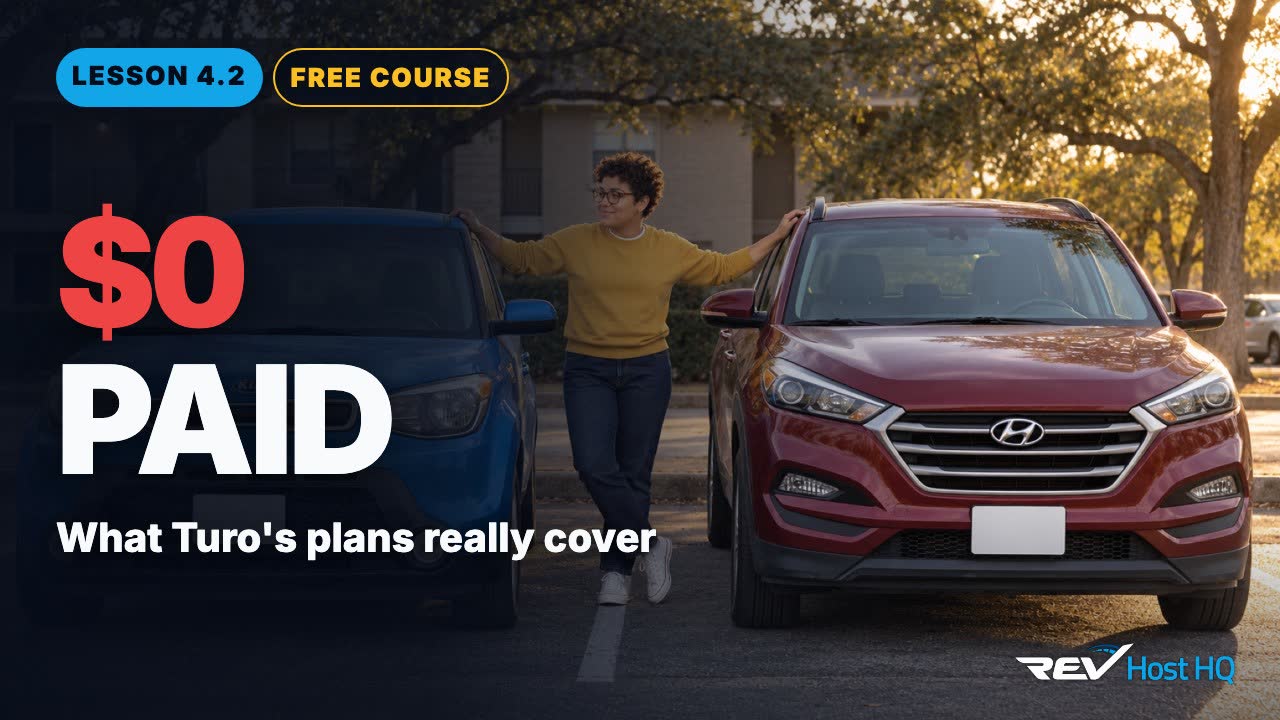
Stolen between trips, and insurance paid zero
Last lesson’s rule: earn the five stars, then ask for them. Now picture this, from one host’s story. A host buys a used sedan. Ten days later, it’s stolen from the host’s own lot, between trips, and totaled in a police chase. Insurance paid zero. The car only had liability.
Turo’s plans protect the trip. Between trips, the car is yours. So here are the three plans, what they never pay for, and the policy you still need.
Turo’s three plans
As of October 2026, Turo has three plans for hosts. Each one sets how much of the trip price you keep, and your damage responsibility: what you pay per damage before the plan reimburses eligible damage above it.
More peace of mind: you keep 70%, and pay up to $250 per damage. Balanced: 80%, and $1,500. More earnings: 90%, and $2,750. All three include liability, up to $750,000.
And Turo says it plainly: Turo is not an insurance company.
| More peace of mind | keep 70% · up to $250 per damage |
| Balanced | keep 80% · up to $1,500 |
| More earnings | keep 90% · up to $2,750 |
| Liability, all three plans | up to $750,000 |
What Turo never pays
Your damage responsibility applies to every kind of damage: interior, tires, glass, mechanical.
And some things Turo never pays: scratches and dings of three inches or less, mechanical failure, old or worn tires, lost value after a repair, and the income you lose while the car is in the shop.
Small dings don’t add up, either. Several of them under three inches still don’t count, even if together they’re longer. So budget for small dings yourself.
Your call: who covers the car wash crash?
Between trips, Sam takes the Tucson to the car wash and backs it into a pole. Who covers it: Turo’s plan, or Sam’s own policy?
Sam’s own policy. Turo’s plans cover the trip. Even while Sam is delivering a car, Turo gives liability only. So you need a personal or commercial policy that knows the car is on Turo. Hosts report that hiding it from your insurer can get you dropped.
If the car is financed or leased, check that contract too. It may have its own rules about renting the car out. It’s the same gap from lesson 1.4: the plan lives inside the trip, and the rest of the car’s life is on you.
Which plan? Do the math for each car
Sam’s Tucson earns about $1,800 a month in trips. On the 90% plan, Sam keeps $360 more a month than on the 70% plan. But one claim on the 90% plan costs $2,500 more.
Hosts say: start on the 70% plan while you learn, then move to 90%, with a claims fund.
This is a worked example, not legal or insurance advice. Have a licensed insurance agent check your own coverage.
| Trips | ≈ $1,800 |
| Kept on 90% instead of 70% | + $360 |
| Damage responsibility, 90% vs 70% | $2,750 vs $250 |
| Extra cost of one claim on 90% | $2,500 |
Keep each car’s policy on file
RevHostHQ keeps each car’s insurance card with its expiry date, warns you before it lapses, and logs what each policy costs, per car.
Next lesson: something goes wrong on a trip, and the claims clock starts.